There is a moment every large enterprise reaches when the software they rely on stops serving the business and the business starts serving the software. Workflows are bent to fit system limitations. Workarounds multiply. Entire teams maintain spreadsheets alongside expensive platforms because the platform simply cannot do what the business needs.
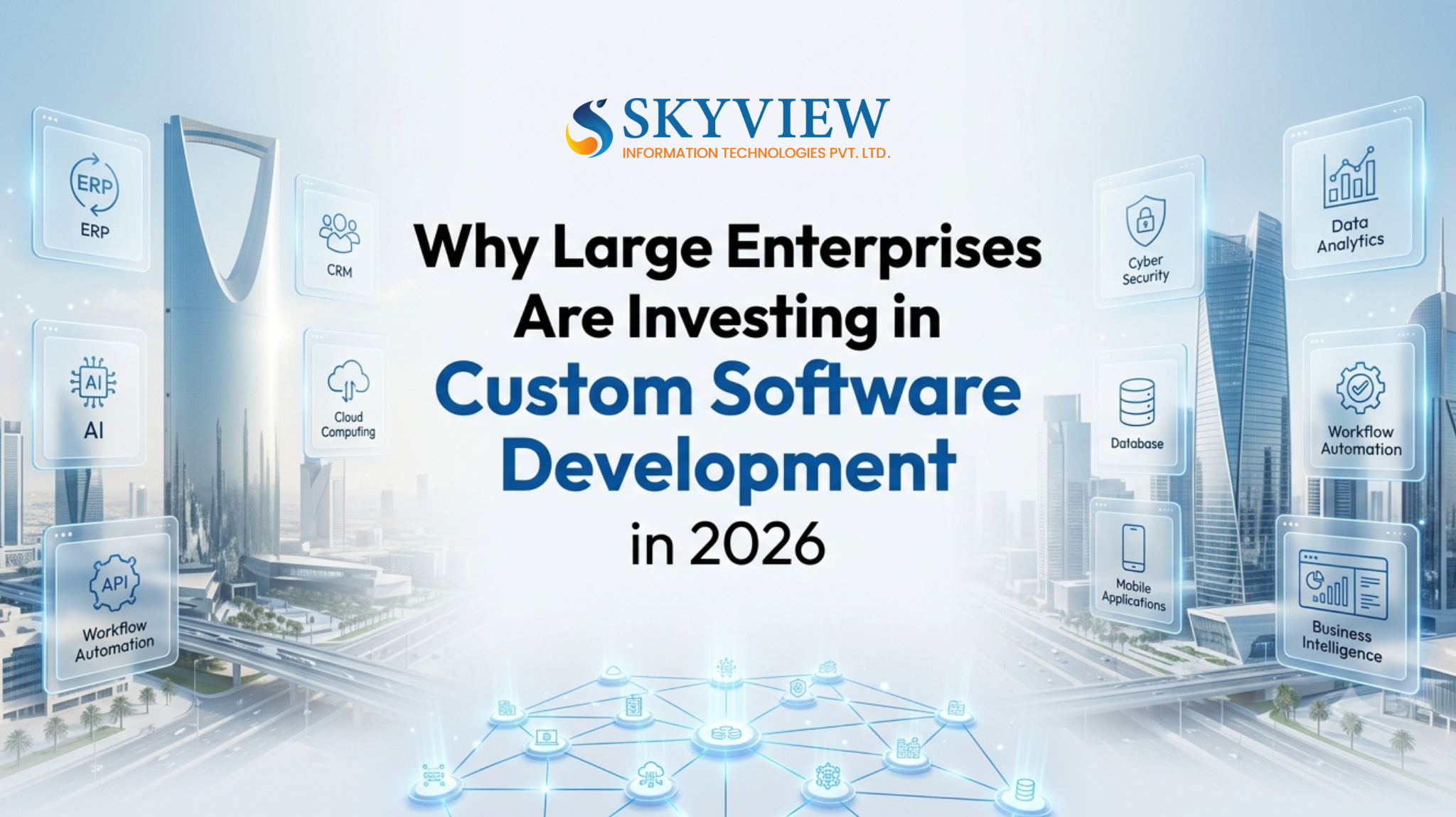
This is the hidden cost of off-the-shelf software at enterprise scale. And for businesses operating in Saudi Arabia’s rapidly evolving economic landscape, where Vision 2030 is raising the bar on operational efficiency, data sovereignty, and digital competitiveness, that cost is becoming unacceptable.
Custom software development is not a luxury reserved for technology companies. It is increasingly the strategic choice of large enterprises across retail, healthcare, logistics, hospitality, and financial services in KSA and beyond for businesses that have decided their competitive advantage is too important to be constrained by a vendor’s product roadmap.
Skyview Information Technologies Pvt. Ltd. builds enterprise-grade custom software that fits the way your organization actually operates. This blog explains why custom development is surging among large enterprises, what to look for in a development partner, and how to approach the decision.
Off-the-shelf software is built for the average business. Your enterprise is not average.
The Problem with Off-the-Shelf Software at Enterprise Scale
Generic software works well at small scale. The problems compound as organizations grow in complexity, geography, and transaction volume. Here is what large enterprises consistently report when they hit the limits of packaged software:
- Process Mismatch
Off-the-shelf software is designed for a generic version of your industry. Large enterprises have differentiated processes, the result of years of refinement, regulatory compliance, and competitive strategy. Forcing those processes into a generic system either limits what you can do or creates costly customizations that break with every software update.
- Integration Complexity
Large enterprises run multiple systems: finance platforms, HR systems, CRM tools, warehouse management, customer portals, and government-facing compliance systems. Getting packaged software to speak to these environments requires expensive middleware, custom connectors, and ongoing maintenance, often costing more than building a purpose-fit solution from scratch.
- Data Sovereignty and Security
For enterprises operating in Saudi Arabia, data residency and sovereignty are not optional considerations. Off-the-shelf cloud platforms often store data on international servers, creating compliance risks with Saudi data protection regulations and sector-specific requirements in healthcare and finance. Custom software can be architected to meet these requirements by design.
- Vendor Dependence and Pricing Risk
When your operations depend on a third-party software vendor, you depend on their decisions, pricing changes, feature deprecations, acquisition by a competitor, or end-of-life announcements. Large enterprises that have experienced a sudden licensing cost increase or a forced platform migration understand this risk intimately.
- Competitive Commoditization
When every company in your sector uses the same software, you compete on the same operational foundation. Custom software creates proprietary operational capability: workflows, customer experiences, and data models that your competitors cannot simply purchase and deploy.
What Custom Software Development Delivers for Large Enterprises
Custom software development, executed correctly, is one of the highest-return technology investments a large enterprise can make. Here is what it delivers:
- Exact process fit: Software engineered around your workflows, not generic best practices, means faster operations, fewer errors, and higher user adoption from day one.
- Unified data architecture: Custom platforms can integrate every system in your enterprise into a single data layer, delivering the real-time visibility and analytics that packaged software rarely achieves.
- Total data ownership: Your data lives where you decide, governed by your security policies, accessible only by your organization. No vendor holds the keys.
- Scalability on your terms: As your enterprise grows, new geographies, business units, and transaction volumes, custom software scales with you. No renegotiating license tiers or hitting platform ceilings.
- Proprietary competitive advantage: Custom-built capabilities become intellectual property. Operational advantages built into your software cannot be easily replicated by competitors.
- Long-term cost efficiency: High upfront investment yields zero recurring licensing costs. For large enterprises, the break-even point on custom development versus annual SaaS licensing typically arrives within 2 to 4 years.
- Regulatory alignment by design: Saudi Arabia-specific compliance requirements (ZATCA, PDPL, sector-specific mandates) are built into the architecture, not bolted on afterward.
Custom Software vs. Off-the-Shelf: The Enterprise Comparison
| Factor | Off-the-Shelf Software | Custom Software (Skyview) |
| Fit to Your Process | Partial — adapt your process | 100% built around you |
| Scalability | Vendor-controlled ceiling | Grows with your business |
| Integration | Limited or costly APIs | Seamless, native integration |
| Data Ownership | Vendor holds your data | Full enterprise ownership |
| Competitive Edge | Same as every competitor | Unique IP and advantage |
| Long-Term Cost | Escalating license fees | One-time investment |
| Compliance & Security | Generic standards | Built to your requirements |
High-Impact Custom Software Use Cases for Saudi Large Enterprises
The most successful custom software projects start with a clearly defined business problem. Here are the use cases where Skyview sees the highest ROI for large enterprise clients:
Enterprise Customer Portals
Large B2B businesses benefit enormously from custom customer portals, self-service platforms where clients can place orders, track deliveries, access invoices, manage contracts, and communicate with account teams. These portals reduce service overhead, improve customer satisfaction, and create a branded digital relationship that generic platforms cannot replicate.
Operational Management Platforms
Enterprises managing complex field operations, logistics fleets, maintenance teams, distributed retail locations, or healthcare facility networks need custom platforms that give supervisors real-time visibility and control. Custom operational dashboards, job assignment systems, and performance tracking tools replace spreadsheet chaos with structured, automated intelligence.
Custom Analytics and Business Intelligence
Generic BI tools give you dashboards. Custom analytics platforms give you intelligence specific to your business model: the KPIs, calculations, and data relationships that actually matter for your decisions. For large enterprises with proprietary data models, custom BI is the difference between reporting what happened and understanding why.
Regulatory Compliance and Reporting Systems
Saudi enterprises operating in regulated sectors, healthcare, financial services, food and beverage, logistics, face mandatory reporting requirements that change regularly. Custom compliance systems automate data collection, format regulatory submissions, and maintain audit trails, eliminating the manual effort and compliance risk of spreadsheet-based reporting.
Workforce and HR Management Platforms
Large enterprises with thousands of employees across multiple locations need HR systems that match their structure, Saudi labor law compliance, multinational workforce management, automated payroll calculation, and leave and attendance tracking integrated with operations. Off-the-shelf HR software rarely covers all of these requirements without significant customization.
Mobile Enterprise Applications
From warehouse floor teams to field sales representatives to executive dashboards, mobile applications extend enterprise capability to every employee regardless of location. Custom mobile apps built for your specific workflows with the right permissions, data access, and offline capabilities drive adoption in ways that generic mobile solutions do not.
The Skyview Information Technologies Pvt. Ltd. Approach to Enterprise Custom Development
Enterprise custom software development carries significant risk when managed poorly. Scope creep, missed deadlines, poor architectural decisions, and inadequate testing have derailed many large enterprise software initiatives. Skyview’s methodology is built specifically to manage and mitigate these risks.
Discovery and Requirements Architecture
Every Skyview engagement begins with a structured discovery phase. We conduct stakeholder interviews, workflow mapping, technical environment assessment, and integration requirement analysis before a single line of code is written. This investment in clarity prevents the expensive rework that derails projects built on assumptions.
Technology Selection Without Bias
We select the right technology stack for each engagement, not the one we are most familiar with or commercially incentivized to recommend. For enterprise clients, this means evaluating front-end frameworks, back-end architecture, database design, cloud infrastructure, and security requirements against your specific scale, performance, and compliance needs.
Agile Delivery with Enterprise Governance
We apply agile development principles: iterative delivery, continuous feedback, and adaptive planning within the governance framework that large enterprises require. Sprint reviews involve your business and IT stakeholders. Progress is visible and measurable from week one, not after a six-month blackout period.
Security by Architecture
Enterprise software handles sensitive data, financial records, customer information, and operational intelligence. Skyview engineers security into the architecture from the beginning: role-based access control, data encryption at rest and in transit, audit logging, and penetration testing before deployment.
Integration Engineering
Custom software that cannot talk to your existing environment is an island. Skyview’s integration team has experience connecting custom platforms to banking systems; government portals, including ZATCA; payment gateways; logistics APIs; and legacy enterprise systems, ensuring your new software enhances rather than disrupts your existing technology ecosystem.
Quality Assurance and User Acceptance Testing
Before any Skyview-built system goes live in an enterprise environment, it goes through structured QA functional testing, performance testing under expected load, security testing, and a formal user acceptance testing phase where your team validates that the software meets the agreed requirements.
Hypercare and Long-Term Partnership
The go-live moment is not the end of the engagement. Skyview provides an intensive hypercare period post-launch, rapid response to any issues, user support, and performance monitoring. Beyond hypercare, we offer long-term development partnerships that ensure your software continues to evolve as your business does.
The best custom software is never finished. It grows with your enterprise.
How to Know if Custom Development is the Right Decision
Custom software development is not always the right answer. Here is a practical framework for large enterprise decision-makers evaluating the build-versus-buy question:
- Build custom when: your core processes are genuinely differentiated and a competitive advantage, not when they are standard industry workflows.
- Build custom when: integration complexity across your existing systems is so high that a unified custom platform would cost less than connecting multiple packaged tools.
- Build custom when: data sovereignty, security, or regulatory requirements cannot be met by available commercial platforms.
- Build custom when: the total cost of licensing, customizing, and maintaining packaged software over 5 years exceeds the cost of building right.
- Buy off-the-shelf when: your needs match what the market already offers well, such as HR administration, standard accounting, and basic CRM, and differentiation is not a factor.
Skyview offers a no-obligation technology assessment for large enterprises evaluating this decision. We provide an honest recommendation, even when that recommendation is not to build custom.
Build Software That Works the Way Your Enterprise Does
Large enterprises that invest in purpose-built software gain something that cannot be purchased off a shelf: an operational foundation that reflects exactly how their business works, owned entirely by them, and designed to grow with them.
Skyview Information Technologies Pvt. Ltd. has the engineering depth, enterprise experience, and Saudi market understanding to deliver that foundation. From discovery through deployment and beyond, we are the development partner that treats your software as a strategic asset not a billable project.
Request Your Enterprise Software Consultation
www.skyviewads.com | Serving Globally
Frequently Asked Questions
How much does custom enterprise software development cost?
Enterprise custom software projects vary significantly based on scope, complexity, and integration requirements. Skyview conducts a scoping assessment before providing a fixed-price or milestone-based commercial proposal. Most large enterprise engagements range from foundational platform builds to full multi-module enterprise systems, with pricing structured to reflect the value delivered rather than hours spent.
How long does a custom enterprise software project take?
A focused custom platform for a specific enterprise function typically takes 3 to 5 months from discovery to go-live. Broader multi-module enterprise platforms are delivered in phased releases over 6 to 12 months, ensuring the organization absorbs each phase before the next is deployed.
Who owns the software and the code after development?
You do. Skyview delivers full source code ownership and intellectual property rights to every enterprise client. There are no ongoing licensing fees for the software we build, and you are never dependent on Skyview to continue operating your platform.
Can custom software integrate with our existing enterprise systems?
Yes. Integration engineering is a core part of every Skyview enterprise engagement. We have experience connecting custom platforms with banking systems, ZATCA and other government portals, payment infrastructure, legacy databases, and a wide range of enterprise technology environments.
How do you handle changes in requirements during development?
Requirements evolve, especially in complex enterprise environments. Skyview uses a structured change management process that evaluates scope changes against budget and timeline impact and presents options clearly to decision-makers. Agile delivery means changes are absorbed iteratively rather than causing project restarts.